.png)
Memo2007Ultra
Discover, Collect, Modify, Create, Share, Inspire,
through Art, Games, and Learning

[ KosraNo - Lira ] - Hues - now
Seeing and talking about colors and hues
Different Species have different numbers of cone cells to interpret different wavelengths or frequencies as different hues.
General Idea
for Every Species, each Primary Colors will be different
and therefore does not exactly has a concrete name.
This means that Astralica has different dialects for different species for different wavelengths.
Of course these primary colors can be named after measurements, but it may not be language friendly.
In our case, each primary color name has 3 syllables :
1st Segment : Primary
Used for Stating the Main Hue
3rd Segment : Other stuffs
for now, it just makes things more natural ...
2nd Segment : When Full
Used for stating if the color is mixed with another primary color equally
(aka Level4)
When stating a hue, we need to think of these things mainly:
1. Which Hue is the Dominant (strongest) ?
2. Is it mixed with other primary Hues ?
3. other extra considerations
For laying down the naming convention and formats
Let's assume that a species can see the following Primary Colors :
A, B, C, ...
This means that each of them has their 3 segments / syllables
to notate the primary part, we attach "p", so all the PrimaryParts of the colors are :
Ap, Bp, Cp, ...
Sometimes these primamry colors can be mixed with other primary colors, in this case we can attach a number from 0 to 4, like so :
A0, A1, A2, A3, A4, where 0 is none (so it can be omited) and 4 is mixed with the other color 50/50
Pronouncing the Hue
the full name of a color should be "KosraNoNi - Lira - Klara Ru Taxi - <Hue Name>",
but this is a bit too many syllables, to simplify it, we can have "Kros - Li - Ta - <Hue Name>"
if the context is even clearer that we are referring to a color, then we can just have "Li - Ta - <Hue Name>"
for extreme simplification, just the hue name written in Casual Script should be good.
Hue name structure - 2 primary colors (Dichromatic)
Cats and Canids (Dogs, Wolves, Foxes) only can see 2 Hues, let's call them X and Y for now.
So we are only dealing with a straight line, which is easier
Now we can build our Color Line :
Step 01 : Color Line
let's draw a color line, with 2 major ticks (beginning and end) and 1 smaller secondary tick (middle) and for each segment between a major tick and a secondary tick, we can have 4 smaller segments.
Due to Constrains on Wix, every tick here is a box
0
0.125
0.25
0.375
0.5
0.625
0.75
0.875
1
Step 02 : Main Hue
Here we can say that H0 takes over the left side and H1 takes over the right side,
X
X
X
X
X/Y
Y
Y
Y
Y
Step 02 : Level of Mixing
Now we can append the Mix Level of the other primary colors
Xp
XpY1
XpY2
XpY3
XpY4
/
YpX4
YpX3
YpX2
YpX1
Yp
Hue name Structure - 3 primary colors (Trichromatic)
Since the Human Dialect only has 3 primary colors, Itis guaranteed that a "Hue Circle" can be formed, In this case, Astralica Human Dialect uses the Hue Circle approach, let's try to construct this circle step by step
Step 01 : Color wheel
let's draw a color wheel, with 3 major ticks and 3 secondary ticks and for each segment between a major tick and a secondary tick, we can have 4 smaller segments. Here we will have our primary hue as X, Y, and Z
The convention here is to have X as 0 deg, Y as 120 deg and Z as 240 deg,
and the angle starts on the right hand side, clockwise, just like back in trigonometry.

Step 02 : Primary Chunks
For now we will list the 3 major chunks for X, Y, and Z
so at least we know which part of the circle will be covered by which primary color.
For every tick, this will contain the general color

Step 03 : Mixing Magnitude
now for every tick, we can append the Mixing Level of the other primary colors.

These are Hues, Saturation and Vibrance are Locked to 1
These Hue names by themselves represents it's hue with Sat=1 and Vbr=1
Hue name Structure - 4 primary colors (Tetrachromatic)
Avians (Birds) can see 4 Primary colors, and so does some fishes. According to the pattern : from a 1D Line, a 2D triangle, the next shape is a 3D tetrahedron.
For the Hue Triangle (3-primary-colors) when a color is chosen inside the triangle, it can be projected on the vertices or the sides of the triangle and be saturated (except the middle point). In this case, we can treat the side of the triangle as the skin.
By using a similar concept :
For the Hue Tetrahedron (4-primary-colors) when a color is chosen inside the tetrahedron, it can be projected onto the vertices, the edges and the faces and be saturated (except the middle point)
Vertices and Edges
The vertices and Edges can use the Dichromatic system and Trichromatic Edge system.
Triangle
The vertices and Edges can use the Dichromatic system and Trichromatic Edge system.
Here we will be focusing on the triangle.
Let's assume that all the Hues are X, Y, Z, and W. On a triangle, a hue will be absent, in this case, take W for example.
Region Dividing : Primary Color Dominant Region
Let's start with the XYZ triangle, in this case, we will have the edges : XY, YZ, ZX

on these edges, make a midpoint, these midPoints can be known as : XY4 or YX4, YZ4 or ZY4, ZX4 or XZ4
for each of these Midpoints, connect each of them to the centerPoint of the triangle.
at this point we will have 3 kiteshapes, each belong to their dominant primary color.


Examples
if a color is found in the X-kiteshape region, then it has X as it's dominant primary color
Region Dividing : Kit Webing
let's focus on the X-Kite, since the same principles can be applied to the Y-Kite and the Z-Kite.
the X-Kite has 4 edges : X to XY4 , XY4 to TriangleCenterPoint , TriangleCenterPoint to XZ4 , XZ4 to X
each of these edges can be cut into 4 equal segments, meaning each of these edges will have 3 tickmarks.
for the edge X to XY4, all the tick marks are : X , XY1 , XY2 , XY3 , XY4
in this direction, you can see that the primary color Y is increasing
for the edge X to XZ4, all the tick marks are : X , XZ1 , XZ2 , XZ3 , XZ4
in this direction, you can see that the primary color Z is increasing
we can use both of these edges to say that :
from XY4 to CenterPoint, Z is increasing, so the tickmarks are XY4 , XY4Z1 , XY4Z2 , XY4Z3 , XY4Z4 aka CenterPoint
from XZ4 to CenterPoint, Y is increasing, so the tickmarks are XZ4 , XY1Z4 , XY2Z4 , XY3Z4 , XY4Z4 aka CenterPoint

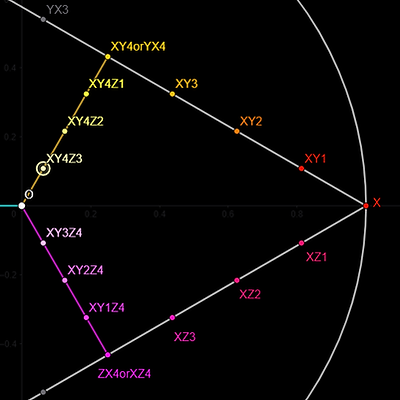
with these tickmarks, we can then create a "squished Cartesian plane" inside this kite.
with this, nine colors can be created
this principle can be applied to other kites
and with the other kites, a triangle is complete, we can also apply the same principle to other triangles, and the whole tetrahedron is done.
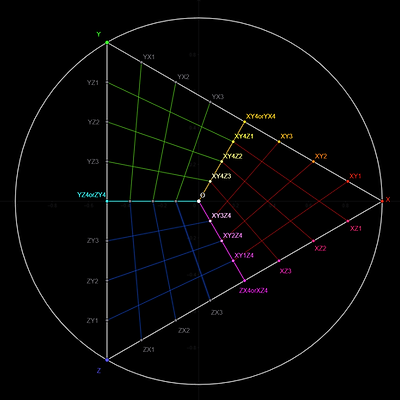

Wait ... CenterPoint ? isn't that the Neutral Color with no Saturation
Keep in mind, here we are dealing with 4 primary colors. To make sure that a color is fully saturated, we need to make sure that :
among the primary color channels, at least one color channel needs to be full, which is the dominant color, and one of the color channels needs to be 0.
For humans, the entire spectrum is the triangle, when the triangle is missing a verticex (one color channel is 0), it collapses into a line, at this point the MidPoint is the Blend of the 2 remaining colors, but still saturated.
For avians, the entire spectrum is the tetrahedron, when the tetrahedron is missing a vertex (one color channel is 0), it collapses into a triangle, at this point the MidPoint is the Blend of the 3 remaining colors, but it is still saturated.
In order for a color to be neutral, all color channels must all share the same value.
Species Specifications
Now we can finnaly list what are the hues for different species :

I would love to contribute to my species ~
If you are a furry who wants to give conlang ideas
join the Discord Server and give a suggestion OwO/
Extra - That name sounds familiar...
Due to coincidence, some of the names are charracters or people from the Internet,
which can be fun and interesting :


Extra - Back in Mah Days
the color format has been evolving across the years
if you are interested in how they evolve, here are the previous versions to describe colors :